Think Like Elon Musk: The Mind Hacks That Build Billion-Dollar Empires
Mark Hamilton reveals the five key characteristics that separate super achievers like Elon Musk, Steve Jobs, and Richard Branson from everyone else—and the exact process to develop each one yourself.
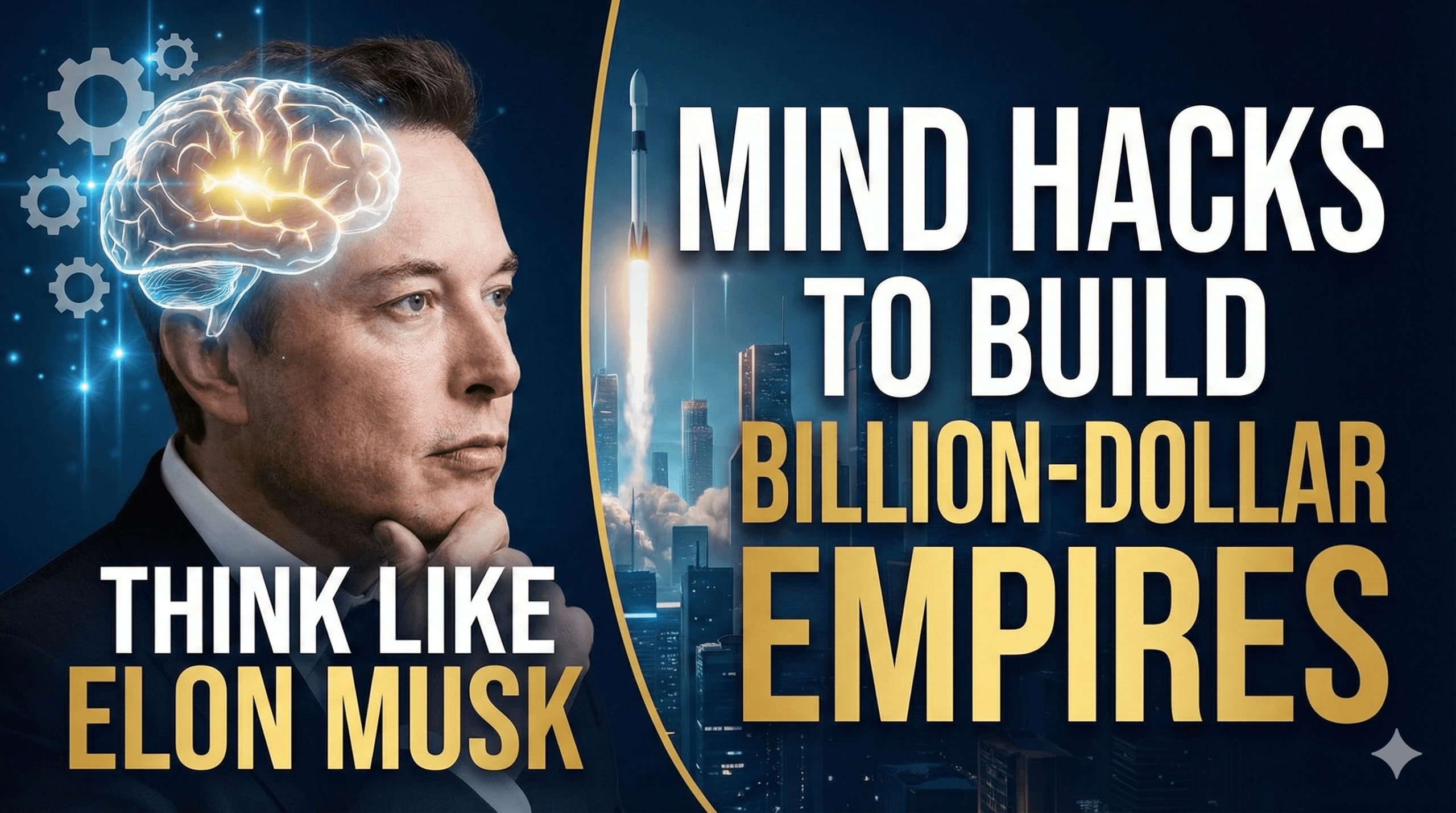
What Makes Super Achievers’ Minds Different?
Super achievers like Elon Musk, Steve Jobs, and Richard Branson share five key characteristics: extraordinary time management, powerful visions, childlike curiosity, driven purpose, and doing what they love. The difference isn’t talent—it’s that they broke out of the “following mode” most people get trapped in and developed a creative, self-leader mentality.
- ✓Super achievers broke out of the “following mode” into a creative, self-leader mentality
- ✓The Mini-Day System creates 8x productivity by breaking work into physical movements
- ✓Power Thinking lets you yank the future into present reality through visions
- ✓Project Curiosity resurrects the child of the past—the source of creative genius
- ✓Create your Area of Purpose to activate your creative mind and build wealth
Why Do Their Minds Work Differently?
Look at the Wikipedia pages of Sir Richard Branson, Elon Musk, or Steve Jobs. You’ll be blown away by how many creative projects they’ve accomplished—boom, boom, boom, one after another. Their minds are constantly springing forth with new ideas.
Mark Hamilton has spent decades studying these super achievers and made a crucial discovery: “Our minds, generally speaking, work a different way. We are presented with things, and we process and react to it. We’re not really springing forth creative ideas all day long.”
“I want to free everyone’s mind. I want to liberate everyone’s mind. I want them to all have a mind like Sir Richard Branson.”
The good news? This creative mind isn’t reserved for a select few. Hamilton has identified exactly what separates super achievers from everyone else—and developed the process to make the shift yourself.
The Following Mode: Why Most Minds Stay Stuck
From birth, we enter consciousness through mimicry. We mimic our parents, our older siblings, then the world around us. This “following modality” continues as we grow up.
The Following Mode
- ✗ Parents tell you what to do → you do it
- ✗ Teachers tell you what to do → you do it
- ✗ Religion tells you what to do → you do it
- ✗ Boss tells you what to do → you do it
- ✗ Military tells you → you do it
- ✗ External authorities run your life
The Creative Mode
- ✓ Generate ideas from within
- ✓ Create values for the world
- ✓ Lead yourself forward
- ✓ Break through limitations
- ✓ Rise in wealth and success
- ✓ You control your destiny
“You’re a good person, so you oblige,” Hamilton explains. “You want to do good, you want to behave, you want to do what’s right, so you follow. That’s the mentality we grow up with and we tend never to break from that.”
Sir Richard Branson, Elon Musk, Steve Jobs, Henry Ford—all the super achievers broke out of the following modality. They developed a self-leader modality, a creative modality. This is what Hamilton teaches: how to break free and enter this liberating creative mindset.
The Five Characteristics of Super Achievers
After studying hundreds of super achievers, Hamilton identified five strong characteristics their minds share. These aren’t innate talents—they’re developed capabilities anyone can acquire.
The 5 Mind Hacks
What all super achievers throughout history share
Time Management
Visions
Curiosity
Purpose
Doing What You Love
Time Management: The Mini-Day System
The Greatest Time Management Tool of All Time
Look at any super achiever’s Wikipedia page—the sheer volume of accomplishments is staggering. How do they do it? Hamilton discovered the answer by applying an old principle in a new way.
The Ford Motor Company Breakthrough
On December 1st, 1913, Ford Motor Company started the first moving assembly line. Before this, workers would gather around each car, doing everything—installing seats, steering wheels, windshields, chassis, wheels.
Henry Ford changed this by breaking car manufacturing down into physical movements. Each person handled one movement. Horses pulled the car along as each man performed his single task.
Result: 8x Productivity Increase on Day One
Hamilton realized: “I’m manufacturing success, just like Ford Motor Company manufactures cars. So let me break everything I do down into physical movements and see what happens.”
“The first day I did that, my productivity went eight-fold—just like Ford Motor Company. Suddenly I had 64 hours a day. I could do in one day what I used to do in eight days. Every Tuesday afternoon, I was done with my week’s worth of work.”
Hamilton named this the “Mini-Day System.” Each physical movement becomes a “mini-day” with its own deadline pressure. Just like studying all semester but learning everything the night before a final—that deadline pressure accelerates efficiency.
Being busy is what blocks us from the creative mind we’re supposed to have. When you’re too busy, you can’t think creatively. The Mini-Day System frees your mind, liberating it for creative thought—the first step into getting a mind like Sir Richard Branson.
Visions: Power Thinking
Yanking the Future Into Present Reality
When Hamilton had three to four days left over each week, something magical happened: he started having visions of things he wanted to accomplish. “Up until then, I was just basically a writer/secretary trying to keep up with my work. Now I started thinking creatively.”
Hamilton’s First Vision: The Ireland Project
Hamilton envisioned mailing literature from the UK into the United States—a major project that could make the company substantial money. Before the Mini-Day System, he would never have even thought of this—he was too busy.
Within weeks, he was meeting with John Fitzpatrick, the equivalent of the postmaster general of the Irish postal service, working out the deal. He had 23 such projects running simultaneously—all advancing in one week.
The Power Thinking Process
Envision your completed goal—the final result you want to achieve
From the end, identify each step needed, moving back to the present
Convert each step into physical movements—calls, emails, meetings
Insert tasks into your Mini-Day System and execute at 8x speed
“You just yank the future down—quick action reality right here and right now,” Hamilton explains. “Now I’m entering the territory of a Sir Richard Branson. You see how this works?”
Curiosity: Project Curiosity
Resurrecting the Child of the Past
The curiosity in super achievers’ minds is fundamentally different from ordinary people. “It is the dichotomy, the separation between them and us,” Hamilton observes. “These guys are curious like a child.”
Think about it: how does a blank mind learn to talk? How does a child achieve the momentous event of learning language and concepts? Curiosity drives them. Super achievers never lost that curiosity.
“I look at all these super achievers and I get a very emotional feeling. I am looking at the child of the past in these people. Just look at Sir Richard Branson’s face—how happy he is, always smiling, beaming. He’s living like we did in our youth. We all lost that.”
How to Implement Project Curiosity
Go beyond your job description—understand the whole business
Show genuine interest in what everyone does—they’ll love you for it
Learn how the company started, what the founder went through
Thank people for teaching you—build leadership through appreciation
Through Project Curiosity, “for the first time, you begin to really learn everything about the business. And some things will start showing themselves to you that you never knew existed.” These revelations lead directly to finding your purpose.
Purpose: Areas of Purpose
The Division of Essence
Steve Jobs famously said, “I want to put a dent in the universe.” Elon Musk wants to populate Mars. Sir Richard Branson is driven by planetary conservation. These super achievers have powerful purpose driving them forward.
Your essence as a human being is different from all other animals: we survived through value creation. We’re the only things in the known universe that can actually create values—a table, electronics, art. When you get in harmony with your essence by creating values, your life goes to a whole new level.
The problem? Most jobs are structured through “massive delegation”—this department, that department, splitting responsibilities among 10, 20 different people. This prevents anyone from having a complete picture or being able to create real value.
Split Responsibilities Kill Purpose
Hamilton discovered that the responsibilities needed for any wealth-building project are typically split among many people—“split responsibilities.” Information that needs to come together to move forward is scattered across the organization.
The solution: identify the “mentally integrating responsibilities”—the responsibilities that must come together in one mind to work efficiently—and pull them together into what Hamilton calls an “Area of Purpose” or “Mini-Company.”
How to Create Your Area of Purpose
Understand all the responsibilities across the business
Spot opportunities that could create value and build wealth
Identify which responsibilities need to come together
Ask to handle the “bitchy details” others hate—they’ll gladly give them up
Pull together all mentally integrating responsibilities into one area
“Once you start pulling those nitty-gritty details together into mentally integrating responsibilities, and it opens up your creative mind—wow, they’re no longer a chore. They metamorphize into the most glorious, enjoyable, exhilarating thing in your life. You can’t wait to get to work now. Why? Because you’re driven by purpose.”
Doing What You Love
The Jack London Process
“So many success gurus tell you, find what you love, pursue what you love,” Hamilton observes. “But what happens? It goes into the ‘impractical’ section of your brain. Three weeks after getting fired up at an event, you go back to your old stagnant routine rut. Nothing changes. But I give you the process.”
The Jack London Story
Jack London grew up in a rough area of Oakland, California. He dropped out of school and worked as a child in a grueling cannery, 12–16 hours a day. Yet he had a dream: to become a professional writer.
The odds of a poor boy, dropped out of school, working 16-hour days in a cannery, ever publishing anything? Millions to one. Yet Jack London became the highest-paid author of his era. How? He identified four fundamental physical movements toward his dream:
Intense grammar study
Immense reading program
Self-education at public library
Robust writing program
Hamilton calls your current job your “income mini-day”—it keeps you alive while you build toward your dream. Around this income mini-day, you place the physical movements (mini-days) toward what you truly love. This process “pulls you out of the abyss” into what you’re meant to do.
Sometimes people don’t know what they love. “Maybe the child of the past has died within them. Maybe it’s still alive, but ‘falling leaves of resignation’ have buried that child of the past.” Hamilton has techniques to resurrect the child of the past within you and discover what you’re truly meant to pursue.
The Neothink Mentality: A Self-Leader Mode
Hamilton calls this creative mindset the “Neothink mentality”—contrasted with the following mentality most people are trapped in. It’s a self-leader modality where you’re leading your life and in total control.
“My first solo book in 1984 was called ‘Rapid Power and Wealth Through Iron Grip Control over Everything That Moves.’ That was the Mini-Day Power Thinking system. That was 40 years ago—and it works today. It’s timeless.”
These five characteristics work together as a system:
How the 5 Characteristics Connect
The Mini-Day System liberates mental space for creative thought
With time to think, you start seeing future possibilities
Project Curiosity shows you where purpose can be found
An Area of Purpose lets you create values and build wealth
Doing what you love transforms work into joy
Frequently Asked Questions
Can anyone really develop a mind like Elon Musk?
Yes. The difference between super achievers and ordinary people isn’t innate talent—it’s that they broke out of the “following mode” and developed a creative, self-leader mindset. Hamilton provides the specific process to make this transition.
How does the Mini-Day System create 8x productivity?
By breaking work into physical movements with deadline pressure, you eliminate wasted time and mental switching costs. Just like Ford’s assembly line revolutionized manufacturing, the Mini-Day System revolutionizes personal productivity.
What if I’m stuck in a boring job I hate?
Start with Project Curiosity where you are—learn everything about the business. You’ll discover areas of purpose you never knew existed. Or use the Jack London process to build physical movements toward what you truly love around your “income mini-day.”
How do I get colleagues to give up their responsibilities?
Ask for the “nitty-gritty details”—the tasks everyone hates. People will gladly let you take them. These details are the building blocks of responsibilities, and pulling them together creates your Area of Purpose.
What if I don’t know what I truly love?
Many people have “falling leaves of resignation” burying their child of the past. Hamilton has techniques to resurrect that childlike passion and discover what you’re truly meant to pursue.
Why is curiosity so important?
Curiosity is what allows children to achieve the impossible—like learning language from scratch. Super achievers never lost this childlike curiosity. Project Curiosity is the method to resurrect it in yourself.
What is the Neothink mentality?
The Neothink mentality is a self-leader modality—you’re leading your life, in total control, creating values. It contrasts with the following mentality where external authorities direct your life and you merely react.
Unlock Your Creative Mind
The difference between you and super achievers isn’t talent—it’s mindset and process. Discover how to break free from the following mode and develop the creative, self-leader mentality of the world’s greatest achievers.
Start with one Mini-Day. Everything else follows.