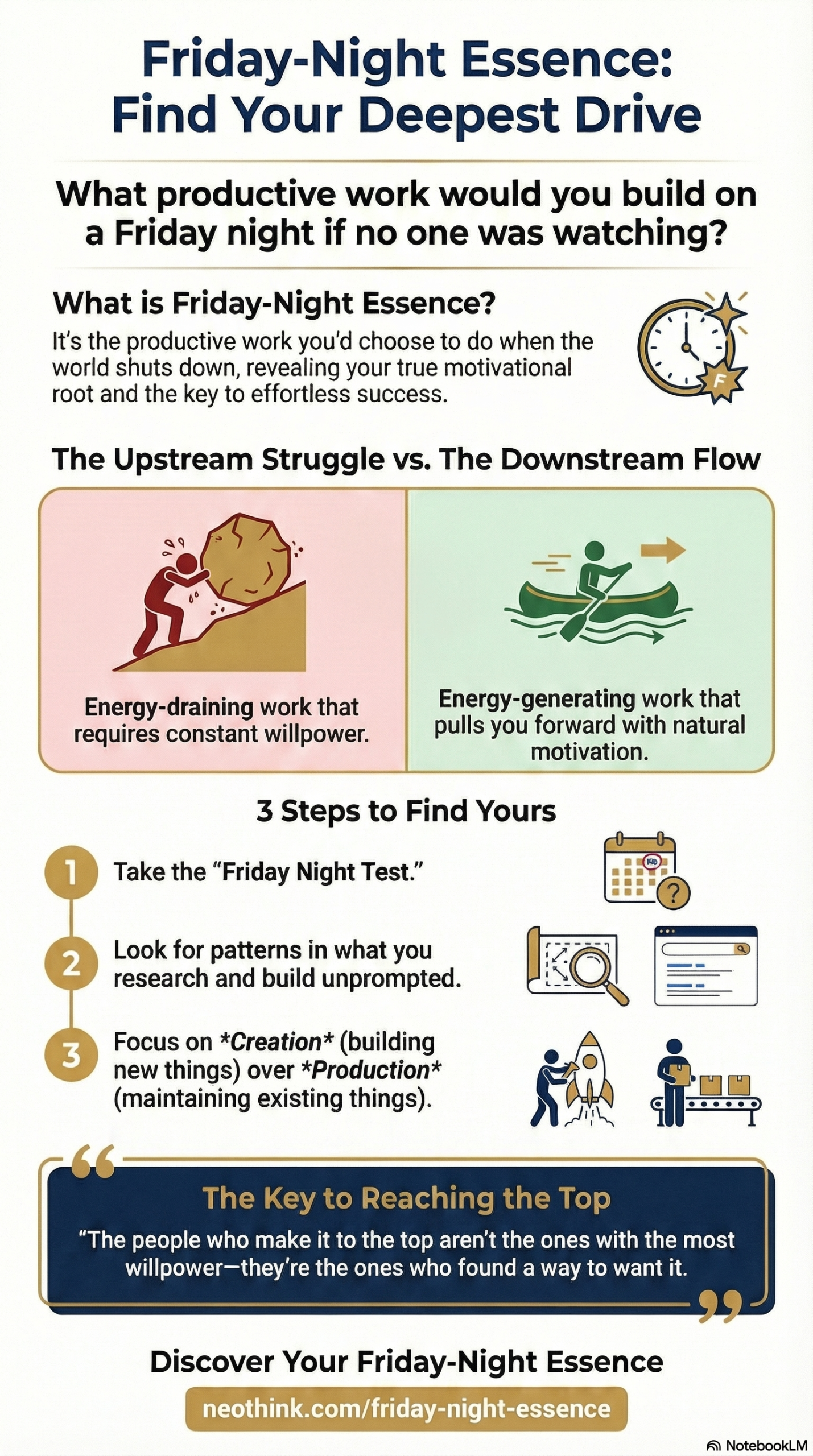
There’s a question that cuts through everything: What would you do on a Friday night if you had nothing to prove to anyone?
Not Netflix. Not drinks with friends. Not the hundred ways we’ve learned to numb out after a long week. I’m talking about the productive thing—the project, the craft, the problem—that would genuinely pull you back to your desk when the rest of the world is shutting down.
Mark Hamilton calls this your Friday-Night Essence. And finding it might be the most important thing you ever do.
In brief: Your Friday-Night Essence is the productive work you’d naturally do when your mind says “shut down.” It reveals your deepest motivational root—and unlocks what Hamilton calls downstream focus, where success pulls you forward instead of requiring constant pushing.
What Is the Friday-Night Essence?
Friday night is when the mask comes off. The boss isn’t watching. The to-do list can wait until Monday. Social expectations fade. What remains is you—and whatever you actually want to do with your time.
Hamilton noticed something about successful people: they weren’t grinding. They were drawn to their work the way most people are drawn to entertainment. Henry Ford would have been tinkering with engines on a Friday night long before he built an empire. Steve Jobs was coding when he could have been anywhere else.
This isn’t about passion in the vague, bumper-sticker sense. It’s more specific than that. Your FNE is the productive activity that doesn’t feel like work—the thing you’d do even if no one paid you, even if no one noticed, even if it was Friday night and you had every excuse to do something else.
That specificity matters. Because when you find it, everything changes.
The Difference Between Upstream and Downstream
Most people are swimming upstream.
They wake up tired. They drag themselves to work. They count the hours until five o’clock, then count the days until Friday. The weekend arrives and they collapse into recovery mode—only to start the whole cycle again on Monday.
This is what Hamilton calls the upstream battle. And no amount of discipline can sustain it forever. Eventually, the resistance wins. You burn out, coast, or quietly give up on the idea that work could ever be anything more than a necessary evil.
But there’s another way to move through life.
When you’re aligned with your Friday-Night Essence, you’re swimming downstream. The current carries you. Work generates energy instead of draining it. Monday doesn’t feel like a death sentence because you’re actually building something that matters to you.
This isn’t motivational fluff. It’s physics. Fighting your own nature takes exponentially more effort than flowing with it. The people who make it to the top of any field aren’t the ones with the most willpower—they’re the ones who found a way to want it.
How to Find Yours
Start with the Friday Night Test. Literally ask yourself: if it were Friday at 7pm and you had no obligations, what productive thing might actually appeal to you? Not should appeal. Actually would.
The answer might surprise you. It might have nothing to do with your current career. That’s fine. The point isn’t to immediately monetize it—it’s to identify the thread.
Look for patterns too. What do you research when no one’s asking you to? What problems occupy your mind in the shower? If money were handled and time were unlimited, what would you build?
And here’s the crucial distinction: your FNE should involve creating something, not just consuming or maintaining. Writing a book is creation. Editing someone else’s manuscript is production. Building a business is creation. Managing processes is production. Designing new solutions is creation. Following established procedures is production.
Creation is where the energy lives.
Why This Unlocks Everything Else
Hamilton’s framework goes deeper than career advice. He sees the Friday-Night Essence as a gateway to what he calls value creation—and value creation as the fundamental purpose of conscious life.
Here’s the logic: when you’re producing (maintaining, managing, executing routines), you’re serving existing systems. When you’re creating (building new things, solving new problems, making something from nothing), you’re advancing life itself. Production keeps the world running. Creation moves it forward.
And creation feels different. Hamilton describes it as “playing”—not in a frivolous sense, but in the way children play: fully absorbed, energized, losing track of time. The wealthy, he argues, didn’t grind their way to success. They played their way there, because they’d found work that felt like play.
Your FNE is the key that unlocks that door.
What If You Can’t Find It?
Some people identify their FNE immediately. The concept clicks and they know. Others struggle—sometimes for weeks or months.
If you’re in the second group, try Hamilton’s Ten-Second Miracle technique. Look at your current work through the lens of numbers: costs, efficiencies, outcomes. Ask how you could improve them. This numbers-based thinking can shake loose the creative capacity that routine has buried.
You might also look for common denominators across multiple interests. Someone drawn to both writing and teaching might have an FNE centered on communicating ideas. Someone who loves both carpentry and coding might have an essence around building systems.
The surface expression can change over a lifetime. The underlying essence typically doesn’t.
Frequently Asked Questions
Is this just another word for passion?
No. Passion is broad and often includes consumption (passionate about movies, travel, food). Your FNE is specifically about production—what you’d create when no one’s watching. That narrowness is the point. It cuts through the noise to find the signal.
What if my FNE can’t make money?
Almost any genuine FNE can be monetized through value creation. The question is how to position your natural drive in a way others will pay for. Sometimes the path is obvious; sometimes it requires creative thinking about markets and needs. Neothink University teaches methods for this translation.
Can my FNE change?
The core essence tends to stay constant. How you express it evolves. A builder might start with Legos, move to carpentry, then to software architecture. The thread—creating functional structures—remains the same.
What if nothing productive appeals to me on Friday nights?
That’s usually a sign of deep exhaustion or disconnection. Years of upstream work can bury your natural drives. Start small. Notice any flicker of interest in making something—anything. Follow that flicker.
Where This Leads
The Friday-Night Essence isn’t the destination. It’s the beginning.
Hamilton sees it as the entry point to what he calls the Neothink Mentality—a way of operating where creation becomes central to how you live. Combined with integrated thinking and the self-leader mindset, it forms the foundation for becoming a value creator. People who make this shift report something unexpected: not just more success, but more aliveness. The chronic low-grade exhaustion lifts. The Sunday scaries fade. Work stops being the thing you endure and becomes the thing that energizes you.
The Neothink Society has worked with people navigating this transition for over four decades. The path isn’t always quick or easy—untangling years of upstream conditioning takes time. But the destination is worth it.
If something here resonated—if you’ve sensed there’s a version of work that doesn’t feel like work—then maybe it’s time to find out what you’d actually do on a Friday night. The Neothink Society can help you figure that out. So can Neothink University and our coaching programs.
The question is simple. The answer might change everything.